Wednesday, 19 March 2014

ICAI has brought in a " CORRECTION WINDOW "


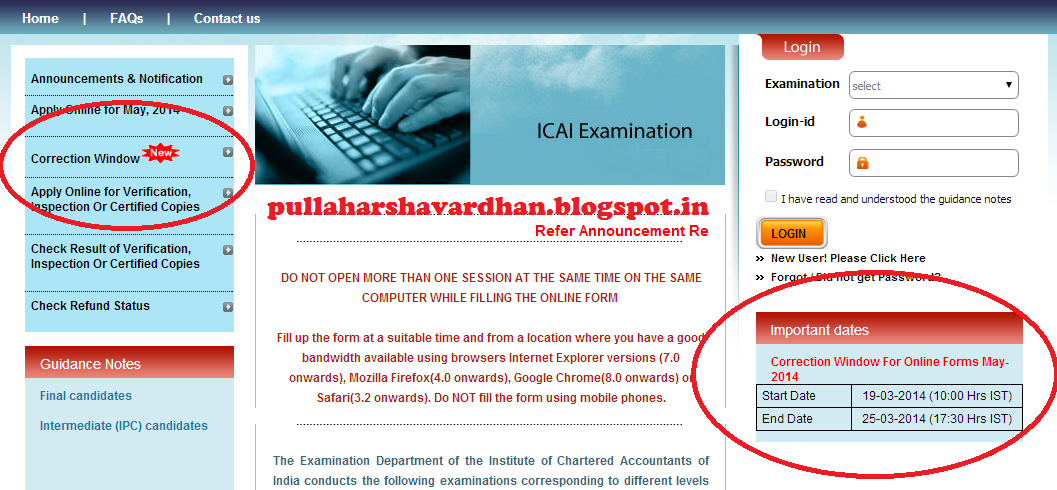
Correction Window

“Correction Window” is a platform in the on line exam form submission process, where candidates can view and correct errors, if any, committed by them while submitting the exam form, in the fields, centre, group and medium opted.
The terms and conditions in this regard are as follows:

1. This facility is available at http://icaiexam.icai.org, from 10.00 a.m. of 19.03.2014 to 5.30 p.m. of 25.03.2014

2. This facility is available only to those who had submitted their exam forms online.

3. This window is not for fresh submission of exam forms and is meant only for correction of errors if any, in the exam forms already submitted.

4. Candidates can access the portal by entering the following details, as filled in by them in their exam application forms:

• Bar code number/control number printed on their online exam form
• PIN ( i.e. the four digit number of their choice which they had filled in their exam forms) and
• Date of birth.

5. Following details, submitted by the candidates in their online examination application form will be displayed on the screen.

  • Name of the candidate
  • Registration number and
  • Group/medium/centre opted

6. Candidates will be permitted to enter changes if any, in any of the following three fields only:

  • City opted. ( Change from domestic centre to abroad centre is not permitted)
  • Group opted ( Change from single group to both groups is not permitted)
  • Medium opted

In other words, no fresh payment of exam fees or refund of exam fees already paid will be permitted on account of correction of groups, made in this process.

7. A change may include change of centre/group/medium either jointly or severally.

8. Candidate will not be permitted to make any corrections/changes to any other field.

9. The requests should be made by the student and not by anyone on his/her behalf.

10. Once you click “No change required”, no corrections can be submitted thereafter. So also, corrections, once submitted, cannot be changed thereafter.

11. The facility will be available free of cost.

12. The candidate should upload scanned copy of a handwritten application in this regard, duly signed by him, seeking the corrections required. Unless this condition is complied with, the candidate would not be able to submit corrections sought, online.

13. Those candidates ( who had submitted their exam forms online) and who might have already submitted a handwritten request for change of centre/group/medium, are advised to submit such request/s, online, through this Correction Window, once again. Changes sought through the Correction Window will be treated as final.
14. Admit cards will be issued based on the examination application form and the correction received till the Correction Window closes.

15. Those who had submitted physical OMR exam forms and seeking corrections in the fields mentioned above, may contact the exam department at:

     Final candidates: final_examhelpline@icai.in

     Indermediate (IPC) candidates:
      intermediate_examhelpline@icai.in 

Download the Full Notification


Procedure To Use the “ Correction Window ” 

Step 1 : Open www.icaiexam.icai.org and click on the Correction Window Option located at the left side 


Step 2 : After reading the Instructions , Click on the Button “ I Have read And Understood the Above "


Step 3 : Fill All your Details as below and Click “ Login ”

Step 4 : All your Details will appear and To make changes Click On “ Change Required ”


 Step 5 : Fill the Details which you want to change & 

Click Submit . 


“Sharing IS Caring”


Sunday, 16 March 2014

Applicability of The Companies Act 2013 - November 2014 CA Exams


The Central Government has notified 98 sections of The Companies Act 2013 on 12th September, 2013. Accordingly, those 98 notified sections are applicable for November 2014 examinations corresponding to their bifurcation into the Intermediate (IPC) and Final Course(s), i.e. from these 98 sections, 53 sections have been included in the Paper – 2, Business Laws, Ethics and Communication, Intermediate (IPC) Course, and 45 have been included in the Paper- 4, Corporate and Allied Laws, Final Course.

For reference and benefit of our students, the Board of Studies has released the following publications relevant for November, 2014 examinations for Paper – 2, Business Laws, Ethics and Communication, Intermediate (IPC) Course, and Paper- 4, Corporate and Allied Laws, Final Course:


Supplementary study material for Intermediate (IPC) Course


Intermediate (IPC) Course
SYLLABUS
__________________________________________________

PAPER – 2 : BUSINESS LAWS, ETHICS AND COMMUNICATION
PART I – BUSINESS LAWS (60 MARKS)


Business Laws (30 Marks)
1. The Indian Contract Act, 1872
2. The Negotiable Instruments Act, 1881
3. The Payment of Bonus Act, 1965
4. The Employees’ Provident Fund and Miscellaneous Provisions Act, 1952
5. The Payment of Gratuity Act, 1972.
Company Law (30 Marks)
The Companies Act, 1956 – Sections 1 to 197
(a) Preliminary
(b) Board of Company Law Administration ─ National Company Law Tribunal; Appellate Tribunal
(c) Incorporation of Company and Matters Incidental thereto
(d) Prospectus and Allotment, and other matters relating to use of Shares or Debentures
(e) Share Capital and Debentures
(f) Registration of Charges
(g) Management and Administration – General Provisions – Registered office and name, Restrictions on commencement of business, Registers of members and debentures holders, Foreign registers of members or debenture holders, Annual returns, General provisions regarding registers and returns, Meetings and proceedings.
(i) Company Law in a computerized Environment – E-filing.
Note: If any provision of The Companies Act 2013 comes into force in place of an existing provision under the Companies Act, 1956 or otherwise by way of new provision, the syllabus would accordingly include the corresponding or new provisions of The Companies Act 2013, as the case may be.
Recommended Post


________________________________________________________________


Part II – : ETHICS (20 Marks)

1. Introduction to Business Ethics
The nature, purpose of ethics and morals for organizational interests; Ethics and Conflicts of Interests; Ethical and Social Implications of business policies and decisions; Corporate Social Responsibility; Ethical issues in Corporate Governance.
2. Environment issues
Protecting the Natural Environment – Prevention of Pollution and Depletion of Natural Resources; Conservation of Natural Resources.
3. Ethics in Workplace
Individual in the organisation, discrimination, harassment, gender equality.
4. Ethics in Marketing and Consumer Protection
Healthy competition and protecting consumer’s interest.
5. Ethics in Accounting and Finance
Importance, issues and common problems.
Part III – COMMUNICATION (20 Marks)
1. Elements of Communication
(a) Forms of Communication: Formal and Informal, Interdepartmental, Verbal and nonverbal;
Active listening and critical thinking
(b) Presentation skills including conducting meeting, press conference
(c) Planning and Composing Business messages
(d) Communication channels
(e) Communicating Corporate culture, change, innovative spirits
(f) Communication breakdowns
(g) Communication ethics
(h) Groups dynamics; handling group conflicts, consensus building; influencing and persuasion skills; Negotiating and bargaining
(i) Emotional intelligence – Emotional Quotient
(j) Soft skills – personality traits; Interpersonal skills ; leadership
2. Communication in Business Environment
(a) Business Meetings – Notice, Agenda, Minutes, Chairperson’s speech
(b) Press releases
(c) Corporate announcements by stock exchanges
(d) Reporting of proceedings of a meeting
3. Basic understanding of legal deeds and documents
(a) Partnership deed
(b) Power of Attorney
(c) Lease deed
(d) Affidavit
(e) Indemnity bond
(f) Gift deed
(g) Memorandum and articles of association of a company
(h) Annual Report of a company


SYLLABUS
PAPER – 6 : AUDITING AND ASSURANCE
________________________________________


1. Auditing Concepts ─ Nature and limitations of Auditing, Basic Principles governing an audit, Ethical principles and concept of Auditor’s Independence, Relationship of auditing with other disciplines.
2. Standards on Auditing and Guidance Notes ─ Overview, Standard-setting process, Role of International Auditing and Assurance Standards Board, Standards on Auditing issued by the ICAI; Guidance Note(s) on ─ Audit of Fixed Assets, Audit of Inventories, Audit of Investments, Audit of Debtors, Loans and Advances, Audit of Cash and Bank Balances, Audit of Miscellaneous Expenditure, Audit of Liabilities, Audit of Revenue, Audit of Expenses and provision for proposed dividends.
3. Auditing engagement ─ Audit planning, Audit programme, Control of quality of audit work ─ Delegation and supervision of audit work.
4. Documentation ─ Audit working papers, Audit files: Permanent and current audit files, Ownership and custody of working papers.
5. Audit evidence ─ Audit procedures for obtaining evidence, Sources of evidence, Reliability of audit evidence, Methods of obtaining audit evidence ─ Physical verification, Documentation, Direct confirmation, Re-computation, Analytical review techniques, Representation by management, Obtaining certificate.
6. Internal Control ─ Elements of internal control, Review and documentation, Evaluation of internal control system, Internal control questionnaire, Internal control check list, Tests of control, Application of concept of materiality and audit risk, Concept of internal audit.
7. Internal Control and Computerized Environment, Approaches to Auditing in Computerised Environment.
8. Auditing Sampling ─ Types of sampling, Test checking, Techniques of test checks.
9. Analytical review procedures.
10. Audit of payments ─ General considerations, Wages, Capital expenditure, Other payments and expenses, Petty cash payments, Bank payments, Bank reconciliation.
11. Audit of receipts ─ General considerations, Cash sales, Receipts from debtors, Other Receipts.
12. Audit of Purchases ─ Vouching cash and credit purchases, Forward purchases, Purchase returns, Allowance received from suppliers.
13. Audit of Sales ─ Vouching of cash and credit sales, Goods on consignment, Sale on approval basis, Sale under hire-purchase agreement, Returnable containers, Various types of allowances given to customers, Sale returns.
14. Audit of suppliers’ ledger and the debtors’ ledger ─ Self-balancing and the sectional balancing system, Total or control accounts, Confirmatory statements from credit customers and suppliers, Provision for bad and doubtful debts, Writing off of bad debts.
15. Audit of impersonal ledger ─ Capital expenditure, deferred revenue expenditure and revenue expenditure, Outstanding expenses and income, Repairs and renewals, Distinction between reserves and provisions, Implications of change in the basis of accounting.
16. Audit of assets and liabilities.
17. Company Audit ─ Audit of Shares, Qualifications and Disqualifications of Auditors, Appointment of auditors, Removal of auditors, Powers and duties of auditors, Branch audit , Joint audit , Special audit, Reporting requirements under the Companies Act, 1956.
18. Audit Report ─ Qualifications, Disclaimers, Adverse opinion, Disclosures, Reports and certificates.
19. Special points in audit of different types of undertakings, i.e., Educational institutions, Hotels, Clubs, Hospitals, Hire-purchase and leasing companies (excluding banks, electricity companies, cooperative societies, and insurance companies).
20. Features and basic principles of government audit, Local bodies and not-forprofit organizations, Comptroller and Auditor General and its constitutional role.
Note: If any provision of The Companies Act 2013 comes into force in place of an existing provision under the Companies Act, 1956 or otherwise by way of new provision, the syllabus would accordingly include the corresponding or new provisions of The Companies Act 2013, as the case may be.


Download | Notification


Recommended Posts


Thursday, 13 March 2014

ICAI Recommended books for IPCC


Below given list is of ICAI recommended books for IPCC which is officially mentioned by ICAI as its good to have for easy completion of IPCC syllabus.
GROUP I
Paper 1: Accounting
Text Books
1. First Lessons in Accounting Standards (IPCC / PCC / ATC) – M.P. Vijay Kumar; Snow White; 7th Edition, 2012
2. Accounting for CA- IPCC– Amitabha Mukherjee & Mohammed Hanif, Tata McGraw Hill, 1st Edition, 2009
3. Advanced Accounting (Vol-I and II) – Dr.Ashok Sehgal & Dr.Deepak Sehgal, Taxmann; 6th Edition, 2008
4. Tulsian’s Accountancy for CA – IPCC and Quick Revision Book Gr.I– Dr. P.C. Tulsian – S. Chand; 2nd Edition 2012
5. Advanced Accounts – M.C. Shukla, T.S. Grewal & S.C. Gupta – S. Chand & Company Ltd.; Revised Edition, 2011
Reference Books
1. Students’ Guide to Accounting Standards (CA IPCC / PCC / ATC) – D.S. Rawat, Taxmann, 18th Edition, 2012
2. Simplified Approach to Accounting Standards (for CA IPCC)– CA. (Dr.) Sanjeev Singhal and Sandhya Singhal – Wolters Kluwer (India) Pvt. Ltd. 16th Edition 2012.
Paper 2: Law, Ethics and Communication
Reference Books
1. Bare Act of the Companies Act, 1956
2. Bare Act of the Negotiable Instruments Act,1881
3. Bare Acts of Labour Laws as covered in the syllabus
(i) The Payment of Bonus Act, 1965
(ii) The Employees’ Provident Funds and Miscellaneous Provisions Act, 1952
(iii) The Payment of Gratuity Act, 1972
4. Business Ethics And Communication, V.K. Jain, S. Chand ; Edition 2011-2012
Note: This list has been compiled by the faculty of Board of Studies and is recommendatory in nature. The books mentioned in the list are supplementary to the Study Material and may serve as a practice aid also.
Paper 3: Cost Accounting and Financial Management
Cost Accounting
Text Books
1. Cost Accounting Methods & Problems – B.K Bhar, Academic Publishers; 18th Edition 2010
2. Cost Accounting Principles & Practices– S. P Iyengar, Sultan Chand & Sons Educational Publishers ; 10th Edition , 2005
3. Cost Accounting – V.K Saxena & C. D Vashisht ,Sultan Chand & Sons; 11th Edition, 2008
4. Cost Accounting A Managerial Emphasis– Charles T. Horngren, Srikant M. Datar and George M Foster, Prentice Hall of India; 14th Edition , 2011
Reference Books
1. Cost accounting & Financial Management– Ravi M Kishore, Taxman Allied Services Ltd.; 6th Edition, 2009
2. Principles of Cost Accounting – Edward J. Vanderbeck, Thomsan South Western 15th Edition; 2010
3. Cost and Management Accounting – Basu & Das, Rabindra Library, Kolkata; 13th Edition, 2009
Financial Management
Text Books
1. Financial Management – I.M. Pandey, Vikas Publishing House Pvt. Ltd.; 10th Edition.
2. Financial Management – Text, Problems and Cases – M.Y. Khan and P.K. Jain, Tata Mc Graw Hill Publishing Company Ltd.; 5th Edition.
3. Fundamentals of Financial Management – Prasanna Chandra, Tata Mc Graw Hill Publishing Company Ltd.; 4th Edition.
4. Fundamentals of Financial Management – J. Van Horne and John M. Wachowicz, Prentice Hall; 13th Edition.
5. Principles of Financial Management – R.P. Rustagi, Taxmann; 5th Revised Edition.
Reference Books
1. Financial Management – Theory and Practice – Prasanna Chandra, Tata Mc Graw Hill Publishing Company Limited; 6th Edition.
2. Financial Management – Jonathan Berk and Peter Demarzo, Pearson; 3rd Impression.
3. Fundamentals of Financial Management – Eugene F. Brigham and Joel F. Houston, Thomson South- Western; 12th Edition.
Paper 4: Taxation
Text Books
1. Systematic Approach to Income-tax, Service Tax & VAT – Dr. Girish Ahuja & Dr. Ravi Gupta, Bharat Law House (Edition based on provisions applicable for A.Y.2012-13)
2. Students’ Guide to Income-tax, including Service Tax/ VAT – Dr. Vinod K. Singhania & Dr. Monica Singhania, Taxmann (Edition based on provisions applicable for A.Y.2012-13)
3. Students Handbook on Income-tax, VAT & Service Tax – T.N. Manoharan & G.R. Hari, Snow white Publications (Edition based on provisions applicable for A.Y.2012-13)
Reference Books
1. Income-tax Act, 1961
2. Service Tax Manual – R.K.Jain, Centax Publications P. Ltd.
Note: Students should follow the edition based on the provisions of law applicable for the assessment year relevant for their examination.
Group II
Paper 5: Advanced Accounting
Text Books
1. Advanced Accounting for CA- IPCC – Amitabha Mukherjee & Mohammed Hanif, Tata McGraw Hill; 1st Edition, 2009
2. Advanced Accounting (vol. I and II) – Dr.Ashok Sehgal & Dr.Deepak Sehgal, Taxmann; 6th Edition, 2008
3. Tulsian’s Accountancy for CA – IPCC and Quick Revision Book Gr-II – Dr. P.C. Tulsian, S. Chand, 5th Edition, 2012
Reference Books
1. Students’ Guide to Accounting Standards (CA IPCC / PCC / ATC) – D.S. Rawat, Taxmann; 18th Edition, 2012
2. First Lessons in Accounting Standards (IPCC / PCC / ATC) – M.P.Vijay Kumar, Snow White; 7th Edition, 2012
3. Simplified Approach to Accounting Standards (for CA IPCC)– CA. (Dr.) Sanjeev Singhal and Sandhya Singhal – Wolters Kluwer (India) Pvt. Ltd. 16th Edition 2012.
Paper 6: Auditing and Assurance
Text Book
Student’s Guide to Auditing and Assurance – Aruna Jha, Taxmann Publications Pvt. Ltd.; 2012 Edition
Reference Books
1. Student’s Guide to Auditing Standards – D.S. Rawat, Taxman Allied Services Pvt. Ltd.; 2012 Edition
2. Auditing and Assurance – Varsha Ainapure & Mukesh Ainapure, PHI Learning Pvt. Ltd.; 2009 Edition
Paper 7: Information Technology and Strategic Management
Section A: Information Technology
Text Books
1. Introduction to Computers – Peter Norton, Tata McGraw Hill; 7th edition.
2. Information Technology – Dennis P. Curtin, Kim Foley, Kunal Sen Cathleen Moring, Tata McGraw Hill; 6th Reprint 2000.
3. Fundamentals of Information Technology – Alexis and Mathews Leon, Vikas Publication House; 2nd Edition.
4. Introduction to Information Technology – V. Rajaraman, PHI Learning; 2008.
Reference Books
1. Database System Concepts – Avi Silberschatz, Henry F. Korth, S. Sudarshan, McGraw-Hill; 6th Edition.
2. Database Management Systems – Raghu Ramkrishnan, Johannes Gehrke, McGraw Hill International; 3rd Edition
3. Data Communication and Networking – Behrouz Forouzan, Tata McGraw Hill; 4th Edition
4. Internet: The Complete Reference – Margaret Levine Young, Osborne/McGraw-Hill; 2nd edition, 13th reprint 2008
Section B: Strategic Management
Text Books
1. Strategic Management and Business Policy – Azhar Kazmi, Tata McGraw Hill; 3rd edition, Reprint 2011.
2. Strategic Planning and Management – P.K.Ghosh, Sultan chand & Sons, New Delhi; 12th Edition, Reprint 2011.
3. Strategic Management, Text and Cases – Ravi M. Kishore, Taxman Publications Pvt. Ltd; 2nd Edition, 2011.
Reference Books
1. Exploring Corporate Strategy: Text and Cases – Johnson Gary and Kevan Scholas, Pearson Education; 7th Edition, 2011.
2. Concepts in Strategic Management and Business Policy – Wheelen & Hunger, Pearson Education; 12th Edition, 2010.
3. Strategic Management – John A Pearce II and Richard b Robinson, Tata McGraw Hill; 10th Edition, Reprint 2011.
4. Strategic Management – Fred R. David, PHI; 12th Edition, 2009.
Sharing Is Caring 

Saturday, 8 March 2014

Live Webcast for Tax Amendments - IPCC


ICAI conducting live webcast for Tax Amendments in May 2014 Exams

IPCC         : 29th Mar 2014 from 1:00 PM to 5:00 PM
CA Final   : 5th April 2014 from 1:00 PM to 5:00 PM

These webcast can be viewed online on the time specified above on  www.icaitv.com


Also Read


Also Read 


"Join & Earn Free Shares"


Anger & Love Has no Limits ~ A Short Story ~ Must Read


While a man was polishing his new car, his 6 yr old son picked up a stone and scratched lines on the side of the car. In anger, the man took the child's hand and hit it many times; not realizing he was using a wrench.

At the hospital, the child lost all his fingers due to multiple fractures. When the child saw his father.....with painful eyes he asked, 'Dad when will my fingers grow back?' The man was so hurt and speechless; he went back to his car and kicked it a lot of times. Devastated by his own actions.......sitting in front of that car he looked at the scratches; the child had written 

'LOVE YOU DAD'.

The next day that man committed suicide. . .

Anger and Love have no limits; choose the latter to have a beautiful, lovely life..... Things are to be used and people are to be loved. But the problem in today's world is that, People are used and things are loved....Let's be careful to keep this thought in mind:
Things are to be used, but People are to be loved. 

Watch your thoughts; they become words. Watch your words; they become actions. Watch your actions; they become habits. Watch your habits they become character;Watch your character; it becomes your destiny. I'm glad a friend forwarded this to me as a reminder. God bless you. If you don't share this on nothing bad will happen; if you do, you might change someones life.